Showing posts with label russian culture. Show all posts

Thursday, June 08, 2006

Whatever you do - don't smile!

Via Global Voices Online, I discovered that my post from the other day (when I was chased home by a random drunk fellow) was linked in conjunction with four posts by Brigid on Laughter in the Dark, concerning a similar experience by an American grad student in Volgograd. They're interesting to read - check them out:


Something interesting to note about both my experience and Brigid's: Both of the Maxims (who took me out to the Khrapovitsky estate on Tuesday) agreed that I had probably smiled at the man when he began talking to me, thus convincing him that I liked him and encouraging him to follow me home. This reminds me of something that I posted a long time ago, but which I'll re-post here, taken from the Lonely Planet guide to Russia and Belarus, 3rd edition:


Women are very likely to be followed and propositioned; I encountered this especially in Moscow. Eye contact is enough of an invitation for many men. Men in cars, on foot, in the subway, are all potential threats. Although I do not think the threat itself is very severe, it was certainly disconcerting for the first few days, until I had developed my hardened face.

Andrei, who commented several times on Laughter in the Dark, wrote:


Back to the essence of the problem. There’s one thing I always put very seriously when I instruct my American partners in Russia – NEVER SMILE TO PEOPLE WHO ARE NOT YOUR FRIENDS. Or at least to Russian polite smile (only with your lips). 80% of communication in every culture of the world is done non-verbally. In Russia smiling to strangers – in American way - could mean depending on the situation, “I’m an idiot” or “I want to be your friend” or “I find you very sexy” or “Don’t take my words seriously” or “I’m here not really for doing research but to have some fun”. Smiling is the major reason why American businessmen I know screw up almost all negotiations here. What Americans view as boorish behavior Russians regard as simply serious and businesslike. I bet 50 to 1 you were smiling to the punks on the boat, weren’t you? You thought it was “I don’t want to be rude but…” kind of smile. It wasn’t. Trust me – stop smiling to strangers, become a bit boorish and suspicious – then 99% of your problems would disappear. Be more aggressive and don’t be afraid to be rude when necessary. Learn from successful Russian women.


On one hand, I admit that it is culturally ingrained (for Americans) to smile at strangers who speak to them, whereas this is something that is simply not done in Russia. Therefore I can see how a friendly-American-smile might give the wrong impression.... However, I don't see how that justifies continued harassment when the woman in question (whether me, Brigid or someone else) is no longer smiling and is, instead, shouting "Leave me alone!" to him and "Please help!" to passers by. This seems to be a way of blaming the victim and excusing the aggressor.


My friend L (a young Russian woman) wrote, "I NEVER respond when a guy starts talking to me or even acknowledge his presence. Especially in the evening." Which is essentially the advice advocated by Andrei and the Maxims.... Although even for someone as anti-social as I often can be, that just sounds strange and unfriendly. I don't know that I have any solutions or sensible comments, I just kind of wanted to point all of this out.


Sunday, April 23, 2006

Happy Easter!

No, I'm not a week late... Russian Orthodoxy celebrates Easter (or Paskha) a week later than Western Christan churches celebrate Easter. Why? I don't know. (Feel free to enlighten me! My students said it has something to do with the phases of the moon, although to the best of my knowledge, the scheduling of Western Easter is based on lunar cycles, so I'm not really sure how this works...) Anyway, several people have written to ask me how Russians celebrate Easter, and whether or not they have any pseudo-pagan traditions (i.e. the Easter Bunny) incorporated into their Easter celebration. Well, as far as I can tell (from both last Wednesday's Easter-topic in my conversation class and living with a Russian babushka), Paskha is a purely religious holiday, without much in the way of pagan-holdovers tacked on.

Russians do color eggs, and while nowadays egg-dye kits can be found in some stores, they prefer the traditional method of coloring eggs: boiling them with onion skins to produce eggs of a dark red color, which symbolizes the blood of Jesus. (And as both my students and Nina Mikhailovna said, this is a more natural way coloring eggs, and is therefore healthier.) Traditional Easter foods consist of these eggs, plus two different cakes, one called a Paskha and the other called a Kulich, which can either be purchased at a store or baked at home. Many Russians take these foods to church on the Saturday before Paskha to be blessed. (Yesterday I saw crowds of people laden with such foodstuffs heading to the various cathedrals around the city.) There is some very big and important Orthodox celebration at all of the churches at midnight (between Saturday and Sunday), although I know nothing about what it entails.

This morning, Nina M prepared a bit of an Easter feast for me for breakfast: a Paskha, a Kulich, dyed eggs, a box of chocolates, and ham and cheese sandwiches. Tons of food and quite delicious. So there you go, my little bit of knowledge on Easter traditions in Russia ends here.
Image hosting by Photobucket
Eggs boiling in onion leaves. This requires brown eggs to begin with.
After Nina M boiled them, she let them sit in the onion leaves for about
24 hours and then boiled them again.

Image hosting by Photobucket
The end result.

Image hosting by Photobucket
An Easter cake with Easter eggs.

Image hosting by Photobucket
The looked really cool when peeled.

Wednesday, April 12, 2006

Punks and Girly-Girls vs. Sloppy Dressers, Hot Topic and The GAP

I received numerous comments about the punk rock show the other day, with one comment in particular comparing the punk movement in Russia to the commercialized punk image sold at stores like Hot Topic. I also received an email from my friend C (which, sadly, I accidentally deleted) in reference to the notion of Punks in Russia. His comment was that perhaps Russian "punks" are simply the sloppily-dressed kids, as opposed to those who put time and care into their appearance.

I suppose now would be a good time to remind everyone first off that I am not one of those people who takes photos of people she doesn't know, no matter how interesting looking or otherwise photogenic they might be. I wish I could do this, but every time I see someone I don't know, but whom I would love to photograph, I get all shy. I can't bring myself to just snap a picture and hope they don't yell at me (seriously, what would you do if some random person you didn't know started photographing you?). Of course, the other way to deal with this type of scenario is to simply ask for permission to take the photo... but that leads us into the whole issue I have with talking to people I don't know. What issue? Well, I don't talk to people I don't know. Yes, I'm a bit of a nut-ball, but that's just way the cookie crumbles and the genes align.

That being said, let's return to the punk rock show. The only clear-shot I got of anyone was the shot of Elena and Nika (re-posted below), who are the students G and I had accompanied to the show. We know them, we're friends with them, and I don't mind asking them to pose for a picture. Based on appearance alone, these two girls are highly unusual for Russian teenage females. They're wearing very little makeup (Nika might not be wearing any), they haven't fixed their hair, they're wearing plain, simple shirts. (You can't see the homemade Sex Pistols tags and other punkish stuff that Elena in particular has used to decorate her pants and her backpack.) Now, in the States, no one would give these two a second glance. They're just normal teenagers. But in Russia, this isn't just a case of being a little sloppily dressed, this is a huge statement.


As I mentioned above, I don't take pics of people I don't know, and to be honest, the only Russian chic I spend much of my free time with is L, and she's totally an exception to every norm possible (this is meant as a compliment), and as such she doesn't make for a good example of your typical Russian female. I found a pic from last semester of me with Natasha, one of my former students (posted below). I think you'll get the point, although even she isn't as dolled up as many Russian ladies frequently are. (I am *so* dumpy and unattractive next to this girl!)


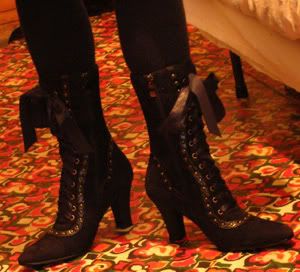
Russian women are hot. And damn sexy. And no, it isn't because we American ladies are fat, ugly lard balls (as certain people have told me). Granted a lot of it is nature (who'd-a-thunk this frigid weather would breed such beauties?), but a lot of it is the packaging. Russian females spend a lot of time on their appearance: Dyeing and styling their hair, appliying make-up, squeezing into impossibly tight and often highly revealing clothes, and finally slipping into ridiculous spiked heels that make my new boots look tame by comparison. Now don't get me wrong; I don't disapprove of this style (and I've bought a lot of really cool clothes here). I do, however, think the pressure to dress as a hyper-feminine sex-pot might be a bit too strong. I know there's been a lot of talk in the media in the States in recent years about teens dressing "too sexy" - let's just say it's nothing like they do here.

But back to Elena and Nika. They have chosen to be different. Even though the picture of them doesn't show them to be all that different from the average American teen, they are vastly different from average Russian girls their age. As a result, they are shunned and mistreated by their peers (G and I have witnessed this in their classes at the AH), and by strangers on the street (I witnessed this the other day). They have chosen the punk music scene as an outlet for their difference, and as a place where they fit in. This is far more punk, more defiant, than strolling down to Hot Topic and buying a commercial, pre-packaged, punk image.

Sorry, this post is kinda rambling and jumping all over the place, but.... back to the way most Russian women dress, and why most American women don't dress that way. My co-workers and I have talked about this a lot. For one thing (and men - you might not be aware of the following, but it's true), in the US, there's a lot of value attached to the idea of "natural beauty" - you might dye your hair, apply a ton of makeup and wear a push-up bra, but the end result is such that you look "naturally beautiful." The idea is for people to think your hair is naturally that color, you boobs are naturally that big and your face is naturally fresh and makeupless. Of course, people who do things like dye their hair pink or purple or black or wear funky makeup and whatnot are not (usually) shunned, they're not considered by, shall we say, fashion mags, to be beautiful. In the US, there's also this idea of "dressing your age." My mom often tells me that I shouldn't dress quite so much like a teenager. She has also been known to make derisive comments about women above a certain age who sport what she considers to be a "young" woman's hairdo. Of course, considering how short my mom's skirts always are.... ;-)

Anyway, in Russia, it's pretty much the opposite. It seems that most women dye their hair. How do I know this? Well (aside from the rootlines...) they dye their hair all sorts of colors. Black. Purple. Blue. Red. Colors that are blatantly fake. And the idea of makeup isn't "natural beauty" it seems instead to be the "Look! I'm wearing makeup! Therefore I'm pretty!" concept. Women of all ages (well, until they become the mythical babushka) dress all sexpot. It's nothing unusual to see middle aged women in short skirts, tight, see-through shirts, and knee-high leather boots on stiletto heels.

Let's take shopping in Russia. Dobryak, the biggest warehouse/market/shopping center in Vladimir, is filled to the brim with clothes. I love shopping there, even though I continually come out of there with things I don't need. Clothes in Dobryak tend to fall into two different categories: Sexpot or Babushka. Meanwhile, US malls are littered with the GAP and GAP knock-offs.
Is there a point to this post? Probably not. I don't dress like typical-anything anyway. But it's interesting to think about.

Thursday, April 06, 2006

What's the deal with those onion domes anyway?

Image hosting by Photobucket
St. Basil's Cathedral, Moscow


I *love* onion domes. They're one of my favorite things about Russia. I think they're incredibly beautiful, and as they're not something you see in the US, I never get tired of photographing them. I have uncountable shots of onion domes, and as I've got three more months to go here in Russia, you know I'm going to collect tons more before I jet on outta here. I've had several people email to ask me questions about these domes I'm forever photographing: What are they for? Do they serve any architectural purpose? Does your house have a dome? Unfortunately, before today I couldn't tell you much other than no, my apartment building does *not* have an onion dome; they're only attached to churches. But as for why, all I could say was that it had something to do with Russian Orthodoxy.

Today, being stuck inside for office hours, with no students coming to meet with me, I was feeling bored out of my mind. This feeling was made even worse by the fact that it's such an incredibly day outside, and that according to weather.com, it isn't going to stay nice for very long. *Must distract self. Must do something on internet.* Aha! I can research the onion dome question. So I did some searching, and here's what I found:

On the roof of Orthodox churches are usually found one or more cupolas (towers with rounded or pointed roofs), called crests or summits. One cupola signifies Christ, the sole head of the Christian community; three cupolas symbolize the Most-Holy Trinity; five cupolas represent Christ and the four Evangelists; seven cupolas symbolize the Seven Ecumenical Councils which formulated the basic dogmas of the Orthodox Church, as well as the general use in the Church of the sacred number "seven"; nine cupolas represent the traditional nine ranks of Angels; and thirteen cupolas signify Christ and the Twelve Apostles.
A peculiar feature of Russian Orthodox churches is the presence of onion-shaped domes on top of the cupolas. In the early history of the Russian Church, especially in Kiev, the first capital, the domes of the churches followed the typical Byzantine rounded style, but later, especially after the Mongol Period, Russian churches tended toward the onion domes, which, in many places, became quite stylized. Historians are not in agreement as to the origin of this particular style, but some point to the possible influence of Persia on this peculiar feature of Russian church architecture, while others argue that since this style was more popular in the far North of Russia, it had a practical application, in that the shape was particularly suited to shed the large amounts of snow common in the region.
(Taken from OrthodoxWorld.com)

Wednesday, February 01, 2006

Baby B is here!

Congratulations to my coworker Male B and his wife Alyona... their son was born last night :-) I'll post a picture or two as soon as I can. As it is, Alyona will be in the maternity hospital through Monday or Tuesday, and Male B has only been able to see his baby a couple of times (very different from the American way of allowing the father in the delivery room and all). Congratulations!

Wednesday, November 16, 2005

Cancel the Fourth of July!!!

I have been meaning to write about this for some time now (the past 11 days, actually), but I haven't really felt the muse hit me until today.

If you are an American, imagine that the US Government canceled the Fourth of July. (Those of you from other countries, imagine that the most patriotic holiday of your country was canceled. Those of you from Russia, I welcome your input on this topic.) Imagine that instead of celebrating Independence Day on the 4th of July, instead you were told that you would celebrate National Unity on July 1st. Celebration of National Unity would not resemble past celebrations of the 4th of July in any way. No fanfares, no fireworks, no parades, no mention of the founding fathers. Just a day off work, that's all. Imagine how you would feel. Imagine how the bulk of the American populace would react.

Now let's think about Russia for a minute. For decades, November 7th was commemorated with great pomp and circumstance, in honor of the October Revolution which led to the establishment of the USSR. On one hand, the Soviet Union is no longer in existence, which makes celebrating its birth in glory and reverence every year somewhat awkward for the current, non-communist government... however: There are many Russians (most Russians, probably) who grew up in the USSR, and for whom November 7th was a special day of the year, like the Fourth is for we Americans. Russians continued to commemorate November 7th every year following the collapse of the Soviet Union, even if the celebration was not as grand as it had been in years previous.

But not this year. This year, following a presidential decree, the November 7th holiday was abolished, and replaced by a holiday on November 4th, to be called National Unity Day (or People's Unity Day). November 4th is supposedly (the date is debated by historians) the day in 1612 when the Polish usurpers to the throne of the Russian Tsar were overthrown and sent packing back to Poland. According to Russian President Vladimir Putin, "At that time, people of various creeds, ethnicities, and social strata united to save their homeland and to defend Russia's statehood." [text]

On November 3rd, I was in St. Petersburg. M, Y, G and I were in the Peter and Paul Fortress, visiting the various museums therein. The museums normally stayed open until 6:00 (I think), but around 4:00 we were turned away from the Commandant's House on account of it closing early. Misha asked the babushka at the door why it was closing early. Her answer? "Because of the holiday tomorrow." Holiday? That was the first we'd heard of any holiday. So M asked her just that: what holiday? The old woman all but rolled her eyes at him, and mumbled something about unity. At first I thought she had rolled her eyes at the ignorance of foreigners; however, when pressed to explain, she seemed at a loss to say much about the day. It wasn't until the next day when we snagged a copy of the St. Petersburg Times that we learned about National Unity Day. So there we were, in St. Petersburg, the second largest city in all of Russia on National Unity Day, and what evidence did we see of this new holiday? Ummm, well, there was that article in the St. Petersburg Times, and I suppose the Hermitage was busier than usual on account of so many people having the day off work... But other than that? I didn't notice anything special going on.

On November 7th, I was back in Vladimir. In my factory class, my students made a point of telling me that it was the anniversary of the October Revolution. For some reason, I asked them if they wanted to sing me a song. They exchanged quick glances, and then all of them burst out in a rousing, if rather outdated, patriotic Soviet tune. When they had finished, they all laughed. Good times, great oldies. Later, I came home from work to find Nina M's niece (a woman in her forties) visiting. She and Nina M. had wine, candies, cookies and food, and had me dine with them. They told me that even though the government had changed the holiday, and even though there was no longer an official commemoration of November 7th, they were honoring the holiday. After all, this had been one of the most important days of the year for the bulk of their lives, and it seemed disrespectful to act as though it were simply another day. I wonder how many other private commemorations were held that evening.

Some other commentary on National Unity Day:
Russia celebrated a new national holiday Friday, though many people did not even know its name or what it stood for, the Associated Press reports. President Vladimir Putin signed an order last year establishing Day of People’s Unity, designed to commemorate Moscow’s liberation from Polish invaders in 1612 and to replace the longtime Soviet holiday marking the Bolshevik Revolution. State-run television led newscasts with explanations of the holiday and showed footage of people performing traditional music and dances, followed by broadcasts of classic Soviet-era films. In a recent poll conducted by the respected Levada Center, however, 51 percent of respondents did not know what holiday would be celebrated and only 8 percent referred to it by the correct name.[text]

As I see it, there are two reasons why official attempts to find a national idea in the country's history are doomed to failure. First is the highly contradictory and complex nature of our history - all the great movements forward rested primarily on the absence of personal rights and freedoms. Secondly, today's Russia is a state that arose not out of an idea, but out of a conflict between two political rivals: Mikhail Gorbachev and Boris Yeltsin. Instead of being vanquished by the ideals of democracy, communism committed suicide. Gorbachev, the General Secretary of the Communist Party of the Soviet Union, laid the foundations of the market economy while the Soviet Union still existed. More than a decade after the failed coup of 1991, most of the population sees it as more of a farce than as a great battle between good and evil. [text]

Monday, November 07, 2005

A Few Days in St. Petersburg: Tales and Photos

I returned to Vladimir at 5:00 Sunday morning, and I am still in the process of trying to recover from lack of sleep, so if there are some bizarre anomalies in this post, please forgive a tired Annie. St. Petersburg was wonderful, even if I am exhausted and suffering from a damaged knee and blistery feet. I took nearly 200 photos, over 40 of which are (in my estimation) internet-worthy. However, as I have limited space for posting photos while I am overseas (not to mention an unforgivably slow internet connection), I am limiting the number of images I'll be posting to around 9 or 10. No worries, the rest will all be online eventually, just not right now. That being said, let's hear about the trip:

On Tuesday night, after classes finished, J, Y, G, M and I made our way to the Vladimir train station, and caught the night train to St. Petersburg. It was a long (nearly 12 hours) and rather uninteresting train ride, although watching the early morning sunrise was nice, and not really something I often find myself doing, being so big on sleep and all.

Image hosting by Photobucket
Y, me, J

Image hosting by Photobucket
Morning view from the train


Returning to St. Petersburg for the first time since my seven-month stint there back in 2000, was both strange and wonderful. It really was like running into an old, close friend, whom I had not seen in many years. True, there have been some changes: Dom Knigi is in a new location, there are more giant advertisements covering the beautiful facades along Nevsky, some pedestrian-archways (including those into the courtyard of my old apartment) are now blocked by locked, wrought-iron gates, and while the buildings that were hidden away by scaffolding back in 2000 were now uncovered for all to see, different buildings are now shrouded in scaffolds. But these changes were merely superficial. The soul of St. Petersburg has remained the same, rich and vibrant, ready to pull me in and welcome me home.

Anyway, we arrived in St. Pete a little before 10:00am, and made our way to the hostel. We had arranged to stay at
Hostel Zimmer Freie, and I am glad we did. The hostel is a reasonably short walk from the center of town, and (in the winter season at least) costs $12/night/person, which was wonderful for those of us on very tight budgets. Our rooms were large and clean, and we had access to a communal kitchen and bathroom. We could come and go as we pleased, and there were no restrictions on in-hostel imbibing as there are in some hostels in which I've stayed. The main office of the hostel also has a large and inexpensive internet cafe (I only used it once... talk about restraint!), and the staff was great. I highly recommend this place to anyone looking for a cheap spot to crash while in St. Petersburg.

After checking in to our hostel, M called Ina. (M's sister has some Russian friends who live in St. Pete. Even though M had never met any of these people, they were quite willing to meet up with us and show us around the city. Ina was one of these people.) We met Ina and her friends Vika and Natasha in front of the Gostiniy Dvor Metro Station, and began our walk around the city. Ina was phenomenal: she gave us a tour of the historical center that was as good as, if not better than, some of the paid city-tours I've been on in the past. As only J and I had been in Petersburg before, this was definitely the best way to start out the trip. And the day was beautiful: cold but sunny, and perfect for taking all sorts of photos.
Image hosting by Photobucket
Palace Square: Military General Staff Building

After Ina and her friends left us, we spent some quality time in Dom Knigi (a huge bookstore called House of Books, for you non-Russian-speakers), and then explored some CD shops as well. (I desperately must reconfigure my miniscule CD collection. I carefully selected my twenty-four favorite CDs to bring to Russia; however, due to recent events, I have found that I can only listen to 12 of those 24 without totally losing my cool, and even those 12 to which I can still listen have been tainted somewhat. This is why opposites really should attract: after the relationship is over, you can sit back and wonder, "How the hell could I have been with someone who liked to do/watch/listen to *that*?" Instead, everything I am/have/do reminds me of things about which I don't want to think right now. So maybe I'll stop typing about them.) I purchased a total of six CDs: two Zdob si Zdub albums (one with two disks) - they're a group out of Moldova whom I saw last time I was here, and they rock. I brought their first CD with me (it being one of the "safe" twelve), and I hope these three are as good as Tabara Noastra. I'll let you know. I also snagged a double-disk Chemical Brothers set, and the new Gorillaz album, which is, at the least, a start.

After leaving the last of several CD and book stores, we made our way to a Chinese restaurant. One of the things we had all been looking forward to was the opportunity to have good ethnic food while in St. Pete. Traditional Russian food is somewhat bland, and after a while, one's taste buds begin aching for something stimulating. I do not remember the name of the Chinese restaurant, but it's on Nevsky, in between Liteiny and Mayakovskogo Prospekts. The food, while priced by Western standards, was delicious, and we all ate an incredible amount, savoring every mouthful, and enjoying the sensation of spices, in all their intoxicating goodness.

After leaving the restaurant, we walked back to our hostel, purchased some vodka and pomegranate juice, and began preparing for the night out. After becoming rather silly, we headed off towards Griboedev, a dance club located underground in a bomb shelter, where I spent many an evening back in 1999 and 2000. (It was along the rather lengthy walk to Griboedev that I discovered that some of the cross-courtyard shortcuts had now been gated off: slightly disappointing. It was also along the rather lengthy walk to Griboedev, or so I suspect, that I managed to somehow damage my knees. Didn't notice it at the time though...) Anyhow, Griboedev is essentially the same, although the entrance fee seems to have gone up exponentially, and they seem to be building some sort of annex topside. It was strange being there without any of the people I had always gone to Griboedev with. Same place, same types of people, no one I knew other than the Americans I came with. Weird. Russian dance parties tend to start late, and as we had arrived around 10:00pm or so, we were there fairly early. The girls and I got some dancing in just as people were beginning to make their way to the dance floor, but then we had to head out. The boys, having imbibed a bit too much, needed to return home.

The next morning, my feet and knees really hurt. A few days before leaving Vladimir, I had purchased a pair of Russian winter boots. They’re leather, lined on the inside with fur, and have the ubiquitous Russian high-heel, albeit a reasonably short one. These were the only pair of shoes I brought with me, which probably wasn't the wisest decision as I had not yet had time to break them in fully. But, I bandaged up my blisters, popped some Excedrin, and ignored the odd twinges in my knees as we headed out for day two of our city-exploration. It was another nice day, weather wise, although a little cloudier than the day before. We walked down Nevsky to the Church of the Savior on the Spilled Blood (Lovely name, isn't it? The church was built on the site of the assassination of Tsar Alexander II, hence the appellation.), and took a bunch of pictures both outside and inside. I had never been inside of the CSSB before, and it was definitely impressive. Yet again I feel the need to state that if I were a religious person, so many of these places would mean so much more to me, although agnostic that I am, this cathedral was impressive. The interior is completely decorated in the most intricate and beautiful mosaic I have ever seen. We all pretty much stood there with our mouths open for a while, stunned. Any other church or cathedral interior tends to pale in comparison. Wow.

Image hosting by Photobucket
Cathedral of the Savior on the Spilled Blood

Image hosting by Photobucket
Mosaics inside the cathedral


After leaving the CSSB, we lunched at Teremok (a Russian fast-food establishment serving the most delicious bliny (like a pancake or a crepe) that I've ever tasted. I got one with caramel and apples. Yum, yum. I do not understand how McDonald's can stay in business over here when it has to compete with Teremok. I kind of want to open a Teremok franchise in the States. It would pummel the competition.

From there we decided to go to the Hermitage (for those who don't know, this is one of the best art museums in the world, and it is located in the old Winter Palace of the Tsars), although that didn't quite go as planned. Apparently, the Hermitage offers free entry on the first Thursday of each month. This seemed great - free entry, woohoo! - but that meant the place was packed. You aren't allowed to enter the museum without checking your coat as the coat-check, and the coat check was full. We would have to wait in line with hundreds of other people until enough free spaces opened in the coat checks for all five of us to enter the museum. We decided to give up and come back the next day. We left the Hermitage and walked across the Neva to the Peter and Paul Fortress, the original settlement at Petersburg. Historically, this is quite an important place, although it is not the most exciting. We toured the Cathedral of Saints Peter and Paul (impressive, but not as much so after having spent the morning in the CSSB), and I dragged the group to the space museum, being that I am somewhat obsessed with the history of space flight. The first time I came to the Peter and Paul Fortress in 1999, I was able to get my picture taken inside a genuine Soyuz space capsule for the cost of a mere five rubles. The space capsule is still there, although the entry-hatch is sealed off with Plexiglas, and you can only get your photo taken next to it. So I did, of course.


Image hosting by Photobucket
J, G, Y, me - along the bank of the Neva

Image hosting by Photobucket
Me next to the space capsule.

By the time we left the Peter and Paul Fortress, I was hobbling like an old woman. Whatever I had done to my knees the night before had gotten far worse, especially in my left knee, and the blisters on my feet weren't helping matters. As much as I had been looking forward to four straight days of raucous partying, I instead found myself looking forward to a long hot shower and my bed. We walked/hobbled back down to Gostiniy Dvor, where we met up with Ina, and offered to take her to dinner, as repayment for the day before. We took her to the Kavkaz Bar, a wonderful Georgian (as in Eastern European Georgia, not the American South) restaurant I first discovered back in 1999 (it's a block off Nevsky on Karavannaya ulitsa). I am so happy this place is still around as I love, love, love it. The food is absolutely incredible. After a few glasses of dry Georgian wine, some orgasmically delicious eggplant stuffed with Georgian cheese, and some hachapuri (Georgian cheese-bread), I was perfectly willing to hobble my aged self back to the hostel and crash for the evening, which I did.

Friday morning, feet and knees still aching, the gang and I met up with Ina and made a second attempt to hit the Hermitage, and this time we were successful. Now, I must admit that I am a bit of a philistine. I can appreciate good art, but I tend to appreciate it quickly. I know there are many people out there who can spend hours in front of one painting, but I am not that kind of person. And I tend to mainly appreciate art with which I can form some sort of personal connection... and as I am rather a weird person, I tend to like weird and random things. And whenever I have visited the Hermitage, I have always been far more in awe of the architecture of the Winter Palace than the masterpieces contained therein. As this was the first time I'd ever been inside the Hermitage with a digital camera (for which read unlimited photo-taking capacity), I was very excited. The rooms are so incredible and the sheer opulence is simply overwhelming. I was excited that this time I was able to tour not just the art-rooms, but some of the rooms decorated as they were during the time of the Tsars.
Image hosting by Photobucket
Me on the staircase in the Winter Palace

Image hosting by Photobucket
Inside the Winter Palace

Image hosting by Photobucket
Inside the Winter Palace

The luxurious sumptuousness is simply astounding. Room upon room of vast halls, all covered in gold leaf - I cannot even comprehend how people lived like this. Such wealth is mystifying.
Image hosting by Photobucket

The title of this painting is something along the lines of Christian Martyr Drowned in the Tiber. You would thing that with me not being a Christian, this painting wouldn't have done much for me... although I know there are several of you out there who will completely understand why I had to take this picture.

After leaving the Hermitage, we went to Tandoor, and Indian restaurant on Voznisensky, near St. Isaacs Cathedral. The food was excellent. I had another eggplant dish, and while its taste was wholly different from that of the Georgian eggplant dish from the previous evening, it was equally pleasing to the palate. The staff at the restaurant was incredibly helpful and friendly, and come to find out... Vladimir Putin has eaten there! (We saw pictures - we sat at the same table as he did!)

Again, following dinner, I hobbled back to the apartment, while the rest of the gang went off to enjoy the Petersburg nightlife. Luckily, I'd had the foresight to bring along an escapist Robert Ludlum book, which kept me pretty occupied. Besides, I've had plenty of St. P. nightlife fun in my day.

My last day in St. Pete was incredibly uneventful. As the knees were still a wreck, I figured that I should probably take it easy. Besides, it was raining, and I did not really want to be out hobbling in the rain. So, while the rest of the group went out to spend their last day in St. Pete sampling sushi and shopping for souvenirs, I spent some quality time on the internet and then camped out in a cafe near the train station with Robert Ludlum. Uneventful, but relaxing.

Sunday, October 23, 2005

Russian women in politics and business

"Russian political elite is made up of men, said Yekaterina Lakhova, chairperson of the parliamentary committee for the affairs of women, family and youth, on October 7 at the international conference entitled "Women and Democracy." Women hold 56% of state and 70% of municipal posts, but the higher the decision-making level, the fewer women are involved, added Lakhova, who also heads the Women of Russia movement. Out of 450 deputies in the parliament's lower chamber, only 44 are women. In the 180-member Federation Council, the upper chamber, there are only nine women. The only female governor is Valentina Matviyenko in St. Petersburg, the former deputy prime minister for social issues and ambassador to Malta and Greece. This statistics prompt feminists to speak of a patriarchal political culture in Russia. They lament that women are responsible only for a limited range of issues, such as family, healthcare, maternity and child welfare, and education. Is this sufficient for a country where women comprise more than half the population, and where 30% of women earn more than their husbands?"

Friday, October 21, 2005

Nina M is a wise woman

Last night on television there was a Russian-produced documentary on the lives of Russian "mail order brides" in the United States. I missed the first part of the program (being in my room, sewing buttons on that crazy coat Nina M gave me), but I saw about 3/4 of it. I was surprised at how many different points of view were shown (often such Russian shows tend to be heavily biased, either wholly for or wholly against something). The show mentioned success stories, mediocre marriages, and the case of Anastasia Solovieva King (about which I have written before), who was murdered by her American husband whom she met via the internet. After the show, Nina M and I sat and talked about what we had just seen, and she had some very interesting and rather conflicting opinions on the subject.

She talked about her life, how when she was young and in college (back in the days of the USSR), she knew that when she graduated, she would have a job. Period. This was never something she ever doubted or questioned. She knew that she would be working as a German teacher in Vladimir several months before she earned her degree; she did not have to worry about finding work. She said that even though her salary was small, it was enough to live on and it was enough to purchase everything she needed and to have a nice, decent life. Nowadays, when Russian students graduate from college, they have a very, very difficult time finding work, and many end up in unskilled, low-paying jobs, such as trolleybus conductor (person who collects the money from passengers). Due to inflation, it is next to impossible to survive on such low-paying jobs, much less live well. She said that she cannot blame young women, with all of their lives ahead of them, for looking to other countries for opportunities to live well. She completely understood their motives; however, she said that when these women leave behind their friends, family members, and their culture, they should not be surprised if they are unhappy in their new lives.

One of the women interviewed on the program was still with her American husband, but was unhappy. She seemed thoroughly disillusioned that her "wealthy American husband" lived in a dirty, low-quality trailer. Nina M said that many, many Russians are convinced that all Americans are wealthy and that life is easy and happy for all Americans. (I too have heard this from many Russians.) We discussed some of the problems in the US - like the fact that many Americans do live in such poor-quality mobile homes, or in public housing, and that many Americans also have a hard time finding work. (I told her about the deer job. You know, the six months I spent ripping jaw bones out of dead deer for minimum wage. Glamorous.) I completely understand that life in Russia is a lot harder on average, although the point wasn't to say that our problems were equal, but that all countries everywhere have problems. Nina M went on for a good while about the importance of realizing that societies everywhere suffer from different ailments, and that anyone who travels to another country thinking that life there will be perfect is simply foolish.

There is simply no way that any sane, rational person can view the story of Anastasia King without revulsion. I had read of her murder (which led to the International Marriage Broker Regulation Act, which has yet to be passed by congress), although watching the segment on it last night was simply horrifying. Aside from the creepy fact that the beautiful young Russian woman had married an overweight, unattractive fellow who was at least twice her age, he made all of these creepy videos of her (which were shown on the program), including sections where he was forcing her to kiss him in front of the camera, obviously against her will. Both Nina M and I were in shock after watching the footage and the tale of her murder (Russian TV tends to be a bit more graphic than American TV).

Anastasia was King's second "mail order bride" - his first had left him and filed a restraining order against him. Before coming to the US, any criminal history Anastasia might have had would have, by law, been told to King; however, King's criminal history was not revealed to Anastasia, because there is no law requiring that such information be passed on to potential spouses. The IMBRA would change that, although its passage seems unlikely. Nina M seemed to think that it was only fair that if the Russian is required to undergo a background check, the American do the same. She did not seem to see why anyone other than a criminal would oppose such a law.

As I said, the show was fairly well rounded, and they interviewed a couple (young Russian wife, middle-aged American man) who were happily married. The man (the author of a book entitled To Russia For Love, which is not listed at Amazon.com) made a point of saying that if you marry a Russian woman, you have to realize that she is from a very different and very rich culture, and that it is important to understand and appreciate her culture and to incorporate parts of her culture into your life. Nina M seemed to think that such marriages were rare, although she reiterated her comment that given the current situation in Russia, even an unhappy marriage abroad might be preferable to life here, happy marriage or no.

Tuesday, October 04, 2005

A picnic "in nature"

Three of M's students (Andrei, Igor and Constantine) invited him, and any of the rest of us who were interested, to go into the country for a picnic on Sunday. The weather was still so unbelievably wonderful, that I had to accept the invitation. So, M, G, J and I embarked on a little journey with some Russians. They arrived at the AH at about 10:30am and told us that they had vodka, wine and beer, and that we needed to go to the grocery store to buy vegetables and anything else we might like to drink. Of course, they were very disappointed when we tried to purchase only non-alcoholic beverages, and managed to convince us to buy a liter of beer too. You know, just in case a car full of booze isn't enough for seven people, one of whom is 100lb, low-tolerance me. Igor and Constantine had cars, so we loaded up and headed westward out of the city, we drove about half an hour, and then turned off the road and started down an unkempt dirt track (more like a couple of ruts) through some woods-n-fields. I should mention that they were driving in typical Russian fashion (definitely white knuckle; enough to make you wish the car had seatbelts), and they continued this racecar technique as we bounced across some fields and "into nature" as the Russians say. (My mother would have been proud of them, actually. She is always off-roading in her station wagon. Bouncing along through the wilderness in the Russian car reminded me of several off-road trips I’ve taken with my mom. Hmmm. Suddenly I'm worried about how my poor Echo is faring in her care...) We drove parallel to a small river called the Koloksha for some ways before they found the "perfect spot" for our picnic: a tiny little clearing in the woods just above the shore of the Koloksha. (The Koloksha is a tributary of the Klyazma, the river upon the shores of which Vladimir sits.) This was not the most spectacular of spots by any stretch of the imagination. In fact, the Koloksha was rather unremarkable, and the woods surrounding it were just, well, woods. But it was nice to be out "in nature." The Russians said people go into the countryside for the fresh air and to be able to have fun somewhere without having to worry about cops. Great. We unpacked the cars and immediately set up camp, as it were. They set up a small metal grill, unloaded some firewood, inflated a mattress, spread some blankets, set the hood of one car up as a table/bar, and unloaded the guns. Yeah, I said guns. I must admit I was a little concerned at first. Here I am out in the middle of nowhere with enough booze to kill a small family and a couple of guns. Kinda sketchy. Well, what do I know? They turned out to be BB guns. We wasted a lot of BBs on target practice over the course of our rather lengthy picnic (we didn't get back to the AH until around 6:30pm), and I must say that for some reason I am a much better shot after I have had something to drink. I also have to say that J is a great shot, whether sober or not, and she totally out-shot the rest of us. I also somehow managed to cut myself on the gun. How? I don't know. Ask the booze. Anyway, the Russians had brought some sort of Ukrainian vodka, made with peppers and lemons, which was delicious. Seriously, it was some of the best vodka I have ever tasted, although it was also very potent. We were taught the proper way to drink vodka: chase it with a bite from a sour pickle, kind of like the whole tequila followed by lime thing, russkie-style. Following the vodka, they began to cook the shashlik (essentially Russian barbecue: marinated pork or chicken cooked over a fire), and we broke into the appetizers (some incredibly delicious cheese... mmmm) and the wine. The wine was Georgian (as in eastern European Georgia, not that state north of Florida), and was very smooth and pleasant to the taste. Luckily after that we were left with cheap beer and really bad wine trying to masquerade itself as port. I prefer to drink things that are tasty. We ate several batches of scrumptious shashlik, shot a lot of BBs, and played volleyball, and some rather abhorrent version of volleyball called hot potato, in which I got smacked in the face with the ball. Lovely. Igor had brought his dog, Vesta, who was a lot of fun. I'm really not a dog person at all, but every now and then I run across a dog that I really like. This dog had a very nice personality: she didn't bark, didn't throw herself on me and knock me to the ground, and she played volleyball better than I did (not like that's saying much, really). But seriously, I had never before seen anything like the way she tried to jump up in the air and head-butt the ball. (I tried to get some pictures of this, but unfortunately the shutter always seemed to click a second too late; you’ll simply have to take my word for it.) It was a long, fun and relaxing day, "in nature" (Nina M is always encouraging me to go out "in nature;" for some reason I feel the need to put that phrase in quotes).

Thursday, September 29, 2005

Higher Education in Russia

To clarify before I begin this post: Galya is the 'director' or principal of the AH. Her husband, Alexei, is also employed by the AH doing various things, and in addition, he is a professor of English and Latin at the Vladimir Pedagogical University.

One of Alexei's classes is an English language conversation class. He invited any of the American AH teachers who were interested to come to the Ped today to participate in a discussion on higher education in the United States and how American institutions of higher education differ from their Russian counterparts. I thought the whole experience was extremely interesting. Six of us went. We (the Americans) started the discussion by talking about where we went to college, what type of college it was, why we chose that school, and the advantages/disadvantages to attending said school. Of our group, B went to Stanford, Y, J and I went to small liberal arts colleges (yeah, Sewanee calls itself a University, but as it only has a grad program in Theology, I’m lumping it in with Gordon and Swarthmore), and M went to Indiana University, a big state school. I've written a good bit on my other blog about my opinions of Sewanee, and what I liked and disliked about the place, so there's no point in getting into that here. Besides, this is from Russia with blog, not from small-liberal-arts-college-in-Tennessee blog. The students asked us questions about our schools and our experiences, and we compared the differences between our schools and theirs.

A lot of what I learned regarding the Russian higher education system is incredibly interesting. For starters, when you apply to a Russian university for undergrad, you must apply to a specific department. None of this applying to a college and then declaring your major a few months or a year into your college career. And no changing courses of study, either. Once you are accepted into a department, that's your department until you get your degree or drop out. In order to apply, you do not simply complete an application and submit essays. You must take both a written and oral entrance exam, for which you must prepare extensively. In other words, if you want to study, per say, English lit, you must already have damn good knowledge of English lit to even get accepted. Each department accepts a specific number of students (this varies by both school and department). Let's say for example that the English lit department accepts 30 students. Those 30 can attend the school for free. But, there might be more than 30 students who get to attend classes. Other people who score high enough on the tests can also enroll; however they have pay tuition. (I think the number of "commercial students" is limited, but I don't know for sure.) In the US, we get to choose which courses we want to take and when. There are certain core courses required for graduation and certain courses that are required for each major. However, when we take these courses is rarely predetermined, and we have a wealth of electives to choose from. (For example I, a Russian/PolySci major, got to take Astronomy, Geology, and Pseudopsychology while in college.) For most Russian students, there aren't any electives. Each department has a set of core courses and "electives"; however, the school determines which "electives" will be offered and which courses its students will take and when.

Another really big difference between the Russian and American educational systems is the attitude towards cheating. In the United States, cheating is viewed as a bad thing. If you copy someone else's work verbatim in an essay and neglect to cite your source, that's plagiarism, and will very often cause you to be kicked out of your school. At the very least you'll get a zero, and then you're pretty lucky. Same goes for copying someone else's homework assignment or cheating on an exam. Not so in Russia. The Russian cultural mindset regarding cheating is completely different from in the US. Over here, if you quote someone else's work directly within your work, and neglect to cite it, it does not matter. You are not cheating. The fact that you went out and discovered this information in order to use it in your work shows that you are scholarly. And now that you have read at least the portion of this work that you've copied, surely you now know that information, and therefore you have learned something. (I can almost understand this logic if you are copying out something by hand, but I do not think it can be applied to this modern age where one can simply cut and paste off the internet.) There is also the idea that copying the homework or exam of a fellow student is not cheating; your classmates are obligated to help you! And of course, students are not punished for cheating. Like I said, it is a cultural mindset. No one thinks it's wrong. When B and I mentioned the Honor Codes at our universities, and how there were no teachers in the room for exams and yet no one cheated, this was received with disbelief.

This whole view of cheating as acceptable is quite prevalent in my classes. Cheating on quizzes is very difficult to control, although I try my best. And it is not just the kids. I find adults of all ages hiding cheat-sheets or cribbing off their neighbors. I also discover cheaters after the fact (ex: when I was grading quizzes, I discovered that two students, seated next to one another, both spelled "spacious" as "spaceout.")

Additionally, in case you don't know, a pedagogical university is a university for training people to be teachers. We asked the students in the class (there were about 40) if any of them wanted to be teachers. No one raised their hands. Not a one. They all said that the salaries for first-year teachers in Russia were way too low (roughly $40/mo I think), and thereby really not enough to live on. They were all either planning on continuing to study at another university following graduation, or hoping to get a job employing their language skills (they were all studying English and German).

Unfortunately, there were three Russian classes all together for this conversation, amounting to 30-40 students, and the groups did not know one another. This made them all a bit shy around each other, not to mention in front of the Americans. Only a small handful of the students ended up doing most of the talking. Alexei is planning on inviting us back to the Ped periodically to chat with his conversations students in smaller groups, which will probably lead to more conversation. I will definitely go. Today was fun, and I certainly got something out of it. (Not to mention that Alexei compensated us for our time by giving each of us a very large and scrumptious Russian chocolate bar.)

After the morning at the Ped, we returned to the AH for the monthly staff luncheon. Supposedly the Russians and Americans take turns cooking these lunches, alternately called "Russian Lunch" and "American Lunch." I am sure the Russian lunches will always be better, as they have access to all of the proper ingredients. Lunch today was delicious, and I was totally stuffed. We had borscht, Russian salad, beef stroganoff, potatoes, and a yummy cinnamon apple and ice cream concoction for dessert. Mmmmmm.

Sunday, September 25, 2005

In sickness and, er......

Friday, September 23rd was Male B's wedding. Male B is a teacher at the AH, and this is his second year teaching at the AH. His new wife is a Russian woman named Alyona. I have mentioned Russian wedding traditions before on this blog, but in case you missed it, I'll reiterate: First the bride and groom go to some sort of government office where they are legally wed. Then they, and a very small group of close friends and family, drive around the city, getting their photos taken at city landmarks, and visiting other friends and acquaintances. I think that this type of wedding celebration seems like a lot more fun than the ordeals that traditional American weddings tend to be. Anyhow, Male B and Alyona were married a little after 1:00pm. After a few photo stops, they came to the AH, where we had prepared a small celebration. For starters, as they walked through the AH, we had an American big band march playing. It was selected by the Russians, although we Americans thought it was odd. I don't remember the name of the march, but it is the song of the US Army! (It was on a CD that also had "From the halls of Montezuma to the shores of Tripoli" and "Anchors Away") So, after the rather amusing military march through the house, we all emerged in the backyard, where there was champagne, candy and fruit for everyone. Alexei had written a song (in Russian) about Britt and Alyona, and he played the guitar while we all sang along. (Part of the song included a simulated cannon-salute, performed by G and M popping balloons!) Toasts were given in Spanish (Male B was a Spanish major), English and Russian. There is apparently a Russian tradition where an apple is stuck with many toothpicks. The bride and groom are supposed to take turns pulling toothpicks out of the apple. Each time a person pulls out a toothpick, he/she has to say something nice about his/her lover. According to Russian tradition, whoever pulls the final toothpick will always have the final say in everything in the marriage. Not exactly the sort of tradition I am predisposed to be fond of, but when in Russia… I am not sure if Russians do the whole bouquet tossing thing or not (perhaps Alyona wanted to throw the bouquet to her friends, not Male B's coworkers), but instead of throwing her bouquet, they made a bouquet out of the popped balloons from the song's simulated cannons. All the Americans (male and female) from the AH stood behind Alyona as she tossed the balloon-bouquet. The damn thing came right towards me, and everyone else dove away from it. I instinctively put up my hand and then thought "wait a minute!" It smacked my hand and fell to the ground. Everyone else insisted that it meant I'd caught it. I tend to disagree. If I'd caught it, it wouldn't have ended up on the ground now, would it? Anyhow, we partook of the champagne, fruit and sweets, and then Male B, Alyona and their entourage went on their way. Russians do not have the tradition of trying crap on the back of the bride-n-groom car, so several of the AH people got together and tied a bunch of crap to the bumper. (And we all fervently hoped that they didn't end up with a traffic fine!)

I had been feeling fine all day long. I thought I was finally over my cold. Then, about an hour after Male B and Alyona left the AH, my throat began to ache. I snagged some rather potent cough drops from B, and set off for class. As classes went by, I began to feel less and less like a healthy person. I began sneezing and coughing and my sore throat got worse. I left my last class and went straight home (ahh yes, a fantastically exciting Friday night, that). I arrived home, and Nina M took one look at me and asked me if everything was okay. I had dinner and went straight to bed...

Saturday, I slept until nearly 11:00am (a nice, Nyquil-aided rest) and awoke to feel mostly okay except for the even scarier sore throat. This would not have been a problem, except for the fact that on Saturday at 3pm I was scheduled to give an hour long talk to AH students on the road trip that A and I took this past summer. I had been looking forward to giving this talk, although when I got up, the thought of talking for an hour given the way my throat felt was not pleasant one. But the talk had been scheduled and advertised, so I got dressed and made my way to the AH. The talk (aided by Cepacol and DayQuil) went pretty well, I think. The students all seemed very interested in the trip, and in my photos. Alexei took tons of photos of me giving the speech (inevitably every time the flash went off, my mouth was open, so I am sure they will be ridiculous), and the next time he distributes his photos to the teachers, I will post any that are decent. After my talk, we showed the movie City Slickers, which also seemed to go over well. (There is a lot of physical comedy in the movie, so students with low language skills can still understand the humor.) After the movie, I dragged myself home and returned to bed (mmm, Saturday night, just as exciting as Friday night here….)

Friday, August 26, 2005

My Russia Face

The following is a comment from Baty Landis, one of the authors of the Lonely Planet guide to Russia and Belarus, 3rd edition.

Women are very likely to be followed and propositioned; I encountered this especially in Moscow. Eye contact is enough of an invitation for many men. Men in cars, on foot, in the subway, are all potential threats. Although I do not think the threat itself is very severe, it was certainly disconcerting for the first few days, until I had developed my hardened face.

I do not think I would call it a threat, and I have not experienced any problems whatsoever in my two weeks thus far. (I will say that five years ago, while living in St. Petersburg, I was once offered 100 rubles for my services, but that was the only time I received any unpleasant attention from a stranger.) However, I do know what Landis means when she mentions her face. This is definitely something that I had perfected during my last trip to Russia, although I am currently rebuilding it. For most of my life, I have lived in the American South, land of polite niceties to strangers. I am really only qualified to talk about the American South, and while I have been told that behavior changes as one moves Northward, I do not really know this from experience. But this is how things are in the South (and in San Diego, too). You do not walk down the street and say hello to everyone, regardless of whether you know them or not; however, if you do happen to make eye contact with a perfect stranger, acknowledging the eye contact connection through a smile or a nod is perfectly acceptable, and in some places even expected. Here, you do not do that. During my first few days, I found myself making eye contact with strangers on the street or the trolleybus. They may very well have been staring at me because despite my mild attempts to Russify my dress, I still do not conform with the standard here (see my post from yesterday). Anyhow, I would lock eyes with people, and then feel the American (Southern?) urge to smile or shrug or something. Of course, this did not get any sort of response from the Russians, who no doubt simply thought I was a bit odd. I have definitely been working on my , which is a bit hardened and introverted, if that makes sense. The goal is to give off the impression that even if I am staring at you, I am not actually looking at you; that just happened to be the direction in which my eyes wandered. It is a very fixed and sort of expression. Not that Russians are in any way unfriendly; they simply do not waste time with polite nothings to absolute strangers.